
My work thrives in the liminal space between binaries touching on traditional ideas of craft and identity. I fuse elements from traditional Greek vessel shapes with architectural technological, and armor-like motifs, creating sculptural forms that are aggressive and seductive. Ornamentation becomes a central theme as I exaggerate sharp, spiked, and curved extensions, blurring the boundaries between the natural and synthetic, where fluidity of form reflects the fluidity of identity. This body of work explores themes of power and desire
Each sculpture reaches outward with pointed, menacing spikes while simultaneously embracing soft, curved, almost sensual forms. This mirrors the bold, expressive style found in queer aesthetics and the mechanical precision of technology. My process is rooted in technical precision and informed by human error, allowing each piece to evolve beyond its original design through play, carrying with it the memory of my hand's movement and care. The finished pieces disrupt conventional ideas of beauty and control, offering a blend of fetishism, and the otherworldly. Through these hybrid forms, I engage with themes of transcendence, sacredness, and futures based on conjecture rather than knowledge. I am creating objects that defy easy categorization while inviting viewers to question the boundaries between what we know, the otherworldly, and the technological.
This research examines how hybridity intersects in my ceramic sculpture, challenging conventional notions of craft and identity while exploring themes of power and desire. Through hybrid sculptures that merge organic and synthetic forms, I create a queer futurist narrative that blurs the boundaries between beauty and aggression, nature and technology, the sacred and the fetishized. These works invite viewers to question the distinctions between what they know and what they do not know (otherworldly). By situating my artistic practice within contemporary art, queer theory, and speculative design, I will explore how ornamentation, form, and hybridity express queer identity and futurism. Additionally, I will analyze the historical and cultural influences on my work, such as Greek vessels, fetishism, and sacredness.
Through this analysis, I aim to show how these themes are reflected in my technical process, from construction of form to surface treatments. By considering both the conceptual and material aspects of my practice, I hope to provide a clearer understanding of how queer influences, post-human ideas, and Fusion shape my sculptures.

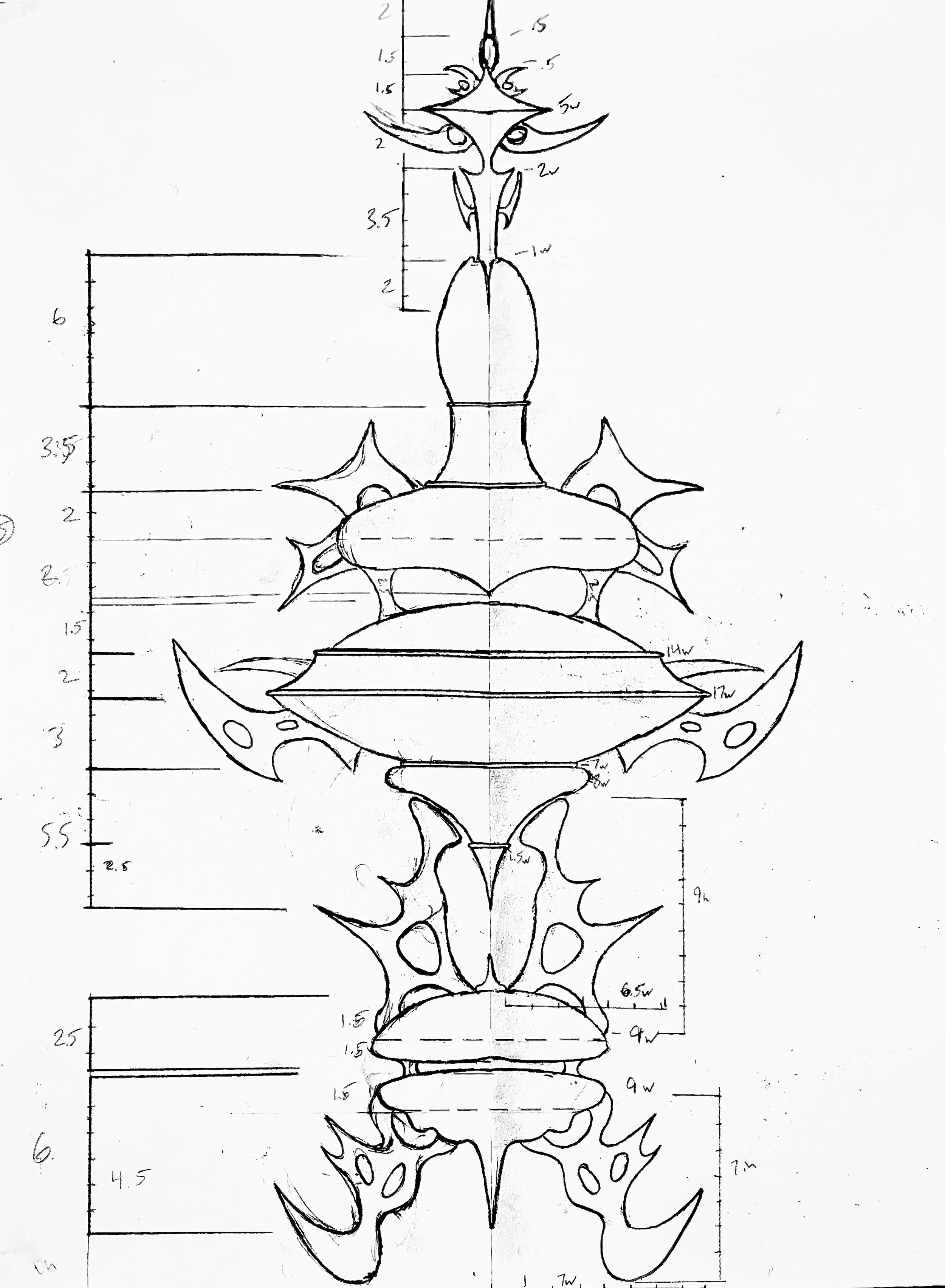
In the process of constructing a new piece, I typically begin by sketching a base design, often drawing inspiration from recent works I’ve completed. I think about new shapes or elements that might alter the silhouette, and I always draw at least half of the piece on a flat surface so I can fold the paper and transfer the design into a symmetrical whole, much like a Rorschach inkblot. Symmetry is important to me because I use it as a visual tool to convey balance, structure, and control, emphasizing architectural precision. I am also reinforcing the tension between natural and mechanical aesthetics; it allows me to create pieces that feel unified and whole.
Next, I plan the scale. I look at my drawing and can scale them up or down in size to my liking, I tend to like objects that range from 30-48 inches in height and it’s also a normal working size that my hands are used to working with. I begin to measure the drawing in centimeters and then convert that measurement into the desired size in inches. After that, I divide the drawing into compartmentalized sections and figure out how best to throw each one on the wheel for the most accurate shape. Planning is a foundational step; depending on the form and the structural needs of the piece, I sometimes make sections thicker or add internal supports to ensure stability, particularly during the kiln firing when thermoplastic clay can warp or affect the structure.
From here, I follow the blueprint I’ve created and begin throwing. As I am working through the blueprints, my process is informed by small improvisation, I allow my intuitive decision making to guide me when constructing. The drawings inform intention, but I can see the truer nature of the object in 3D, I begin to sketch in three dimensions in real time. I throw base forms on the wheel and construct additive sculptural elements that I use to create two-part press molds from. I create these molds to ensure precise replication and shaping of these additive elements. Once all the attachments and additional elements are made, I attach them to the main body, wait 20-30 minutes for the slip’s moisture to equalize, and then clean them up. I put wax resist over all the bonding points where I have adhered the elements to prevent any further cracking from drying shrinkage. Every so often I will continue to burnish around the bonding points to ensure there are no cracks. Once the piece is dry, it is ready to be bisque fired.

These sculptures stand tall or suspend with a prominent vertical axis, resembling a totemic structure. The work is composed of multiple or stacked segments, each contributing to its form. In my work, I reimagine ceramic vessel anatomy by drawing inspiration from the classical silhouettes of traditional Greek forms, blending them with additive elements influenced from ancient architecture and the aesthetics of bladed weaponry. This fusion creates a hybridized language that reshapes and contextualizes traditional structures within a modern conjectured framework. My approach involves employing a deliberate strategy of borrowing, exaggeration, and rearrangement of compartmentalized sections within these diverse influences.
My work draws inspiration from ancient Greek vessels, particularly in the use of classical silhouettes, totemic structures, and ornamentation. My hybrid forms are like Greek ceramics, known for their functional and beautifully adorned forms, embodying a sense of sacredness and civic importance. The borrowing of these shapes and reconfiguring them into futuristic sci-fi forms aligns with historical traditions of using ceramics to convey narratives, yet the narratives are interpreted as futuristic and post-human (if humans aren’t the central character).


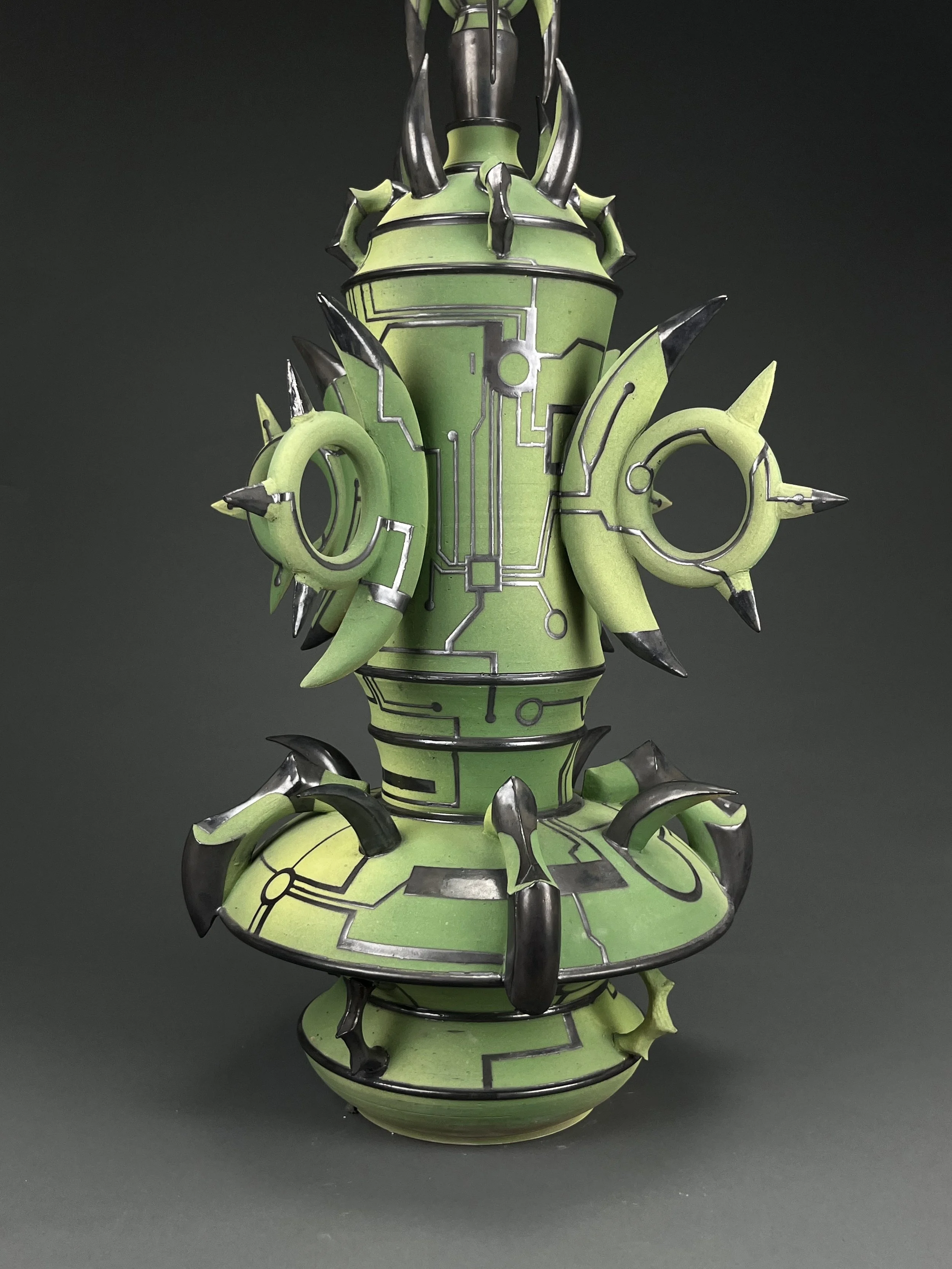
My sculptures are adorned with various sharp, pointed, and curved extensions that protrude from the main body. Thorns, spikes, blades, insectile references, and exaggerated architectural elements give my work an aggressive, predatory, and almost menacing quality. The more organic and curvilinear elements integrate more seamlessly into the design of the main body, adding contrast to the sharpness and providing a sense of balance. Top and bottom segments are particularly elaborate, with an intricate array of spikes and points that culminate around the axis of a central spike that is reminiscent of the piece. The pointed, thorn-like protrusions suggest a natural growth like a plant, but the precision and symmetry of the forms give it a synthetic quality. The work is always reaching, capturing a sense of tension and outward movement.
My construction process is quite different from how I finish a piece. Letting a piece sit with me helps the development of new ideas, allowing the work to evolve naturally over time. For surfaces, I typically use Amaco underglazes, adding visual texture with different colors and hues. With some pieces, I layer a black wash over the colors to create a weathered, post-apocalyptic look, then reapply the brighter underglaze in certain areas to create striking contrasts between muted and vibrant hues. I was inspired and learned this way of surface decoration from the Cochiti clay artist Virgil Ortiz and have been using it for most of my recent work. I also use a metallic gloss glaze in selected areas to enhance the way I want to portray the piece to the viewer. Whether that be industrial or sci-fi aesthetic featuring motifs inspired by motherboards and printed circuitry patterns. I am also fetishizing specific parts of the piece. The more organic moments when viewing the piece up close mimic body parts. When I glaze those moments, I accentuate and compartmentalize them, very similar to the way lingerie accentuates the human body. Thin strips of painter’s tape and customized vinyl cut stickers help me achieve incredibly detailed glaze patterns of circuitry.
When I talk about my work, I tend to relate my work to reliquaries and relics within religion. The reliquaries are some of the highest crafted containers meant to hold something sacred or something that has supernatural power, but the object is usually something that is in its raw state, untouched or crafted in any way. I think of my work being both a reliquary and a relic; appearing to be supernatural yet bonded with the craftsmanship and excessive ornamentation that reliquaries display.

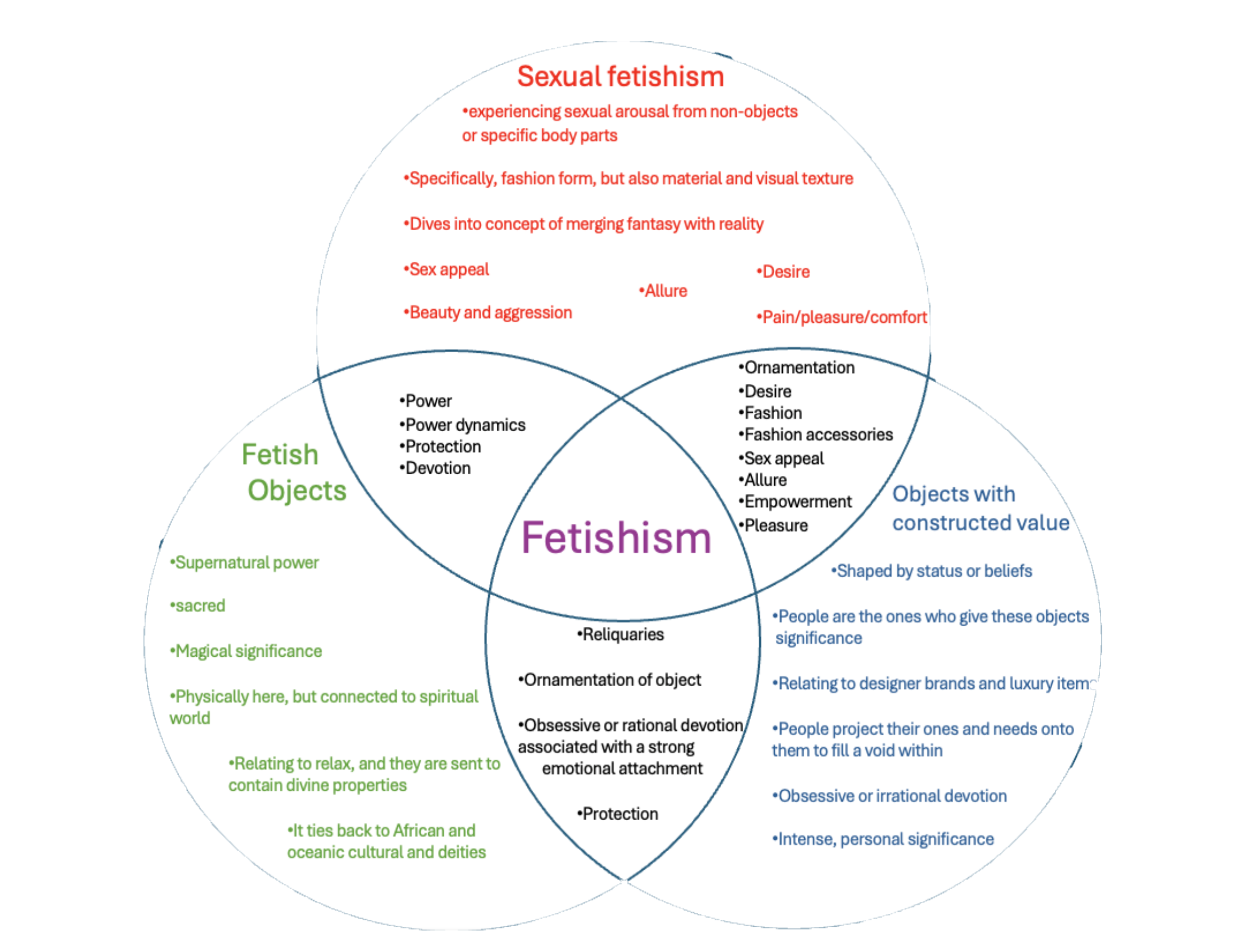
When using the word “fetish” to speak about my ceramic sculptures, I am using it in a way that relates to an object of irrational reverence or obsessive devotion. The term "fetish" has different meanings, first seen in various African, Oceanic, and Indigenous cultures, referring to objects believed to hold spiritual power or magical significance. They involve deities connected to natural elements, embodied in objects that become sacred through rituals. These objects, often called "fetishes," act as a bridge between the spiritual and material world. These objects often symbolize authority, protection, and desire (Capponi 2021). The second being artifacts that are imbued with constructed value, meaning that the object's worth comes from the cultural or symbolic meaning people give it, rather than from its material or practical use. This value is intentionally created by society, shaped by things like tradition, status, or beliefs (Steele, 1996). The third being sexual fetishism. Over time, fetishism’s meanings expanded, intertwining sexuality with themes of power and perception (Steele, 1996). I am creating my work with all three in mind, fluctuating between pieces.
Objects, no matter what they may be, connect us to deeper desires, fears, fantasies and comforts. They can contain our sex, our soul, our spirit. The desire to be surrounded by objects that bring a sense of comfort and well-being has become a common need today. Wanting and dreaming are closely linked, and more often, projecting our hopes and fantasies onto material objects helps to fill the void in people’s lives. This has always been a part of human nature, much like when people once believed in the power of "spirited" objects to ward off evil (Edelkoort, 6). My work that I invest my blood, sweat, and tears into can now fulfill that same deep need. Fetish objects, high heels in particular, transform the body into an erotic symbol, elongating it taller to enhance the allure towards the viewer. High heels have become one of the most popular fetish symbols, empowering and captivating with their seductive form. “Stilettos are seen as phallic and will be used as punishment, whereas a worn and weathered running shoe can become an object to lick and love” (Edelkoort, 6). In this way, I draw parallels between the additive elements and glaze decoration in my work to the power a high heel imparts through its allure not only in itself but the way it is worn. Heels are a weapon and its function is allure. The duality between beauty and aggression through my additive parts give my work a sense of authority.
Scale: My commanding forms physically dominate a space whether they are large or small, creating an impact that demands attention. They imply control and dominance. Scale does more than amplify visual impact; it reinforces themes of power, suggesting an intimidating or revered object, much like a ceremonial monument or a sacred artifact.
Ornamentation: My intricate embellishments convey luxury, value, and importance, turning each piece into an object of fascination. The ornamentation in my work suggests both reverence and fetishism. This elaborate detailing transcends the pieces constructed value, evoking ritualistic or sacred qualities that play on notions of excess and allure.
Weapon inspired elements: Turning each piece into something that could be both defensive and offensive. I am reflecting a fascination with power by creating custom attached elements and treating their surfaces with glaze application to evoke armor, spikes, or blades. These features contribute to the aggressive aspect, portraying the sculptures in a ready to protect or attack stance, while remaining highly aestheticized and neutral due to symmetry.
Curved silhouettes: Organic softness contrasts with the aggressive, weapon-inspired elements. This blend of organic lines with sharper elements creates an interplay between vulnerability and protection, sensuality and hostility. The curves evoke a bodily or organic quality in specific moments around the piece, providing a sense of life or personhood, I use decorative lines to accentuate them similar to how lingerie fetishizes the human body allowing my viewers to see more than just aggression and appreciate the balance of beauty within it.
My work enforces respect, captivation, or allure. The allure I capture in my work connects with themes of fetishism in fashion, where the body is shaped into an object of devotion through wearable items. For example, a corset: it embodies the strive of perfection, molding the body into a submissive, hourglass silhouette that brings a sense of pleasure and empowerment to both the wearer and the admirer. From my own experience when I have worn a corset, I feel both constricted and comforted. The tight grip feels uncomfortable yet also brings a sense of security and makes me feel sexy because of the way it shapes and textures my body. The corset's hold pushes me into a submissive role by physically reshaping me, yet it also empowers me with the confidence that comes from how I’m perceived. It exudes sex appeal, making me feel like the most important person in the room, enhanced by the undeniable allure it creates. This also includes high heels along with all other fetishized wearable garments or objects. They all add up to the feeling of empowerment.
For example, Madonna's cone-breasted corset becoming iconic in 1990 making her a national sex symbol. Her Blond Ambition tour dealt with the fusion of Catholic religious imagery and BDSM placing fashion, fetishism, and religion in the same category. Designers like Jean Paul Gaultier (maker of the Madonna’s corset) and Alexander McQueen have paved a way for fetishism in high fashion and introduced it to the mainstream. Fabrics (but in my case glaze and visual texture) also hold symbolic meanings—velvet suggests intimacy, satin adultery, leather, rubber, and metal represent power, pain, and pleasure. I am not trying to replicate these materials but instead mimic the visual texture to provide similar appeal. Fashion and fetishism have been connected since the 1970s, when sexual liberation and women's empowerment introduced new roles in erotic expression. Fetishism now reaches into art, theater, and film, encouraging role play as part of sexual identity. In fashion, it allows people to use clothing and textures to showcase their own sense of power and shape how others see them (Edelkoort, 6), much like the way drag artists use transformation to transcend their original form.
Transcendence and transformation are what I am trying to convey with this body of work. Within LGBTQIA+ pop culture and media, people who often celebrate ornamentation, flamboyance, and an embrace (especially drag queens and artists of all sorts) of what might be considered "excessive" by more traditional or heteronormative contexts. Drag uses fashion and other aspects of performance to create heightened versions of gender expression Drag is rooted in acceptance and resilience and is an art form that represents freedom of expression and resistance to unjust forces. In other words, drag queens are soldiers for the queer community; their makeup and fashion are their weapons (Smith, 2024).
The Ecstasy of Things by Thomas Seelig talks about how people see themselves and their desires within the things they possess. Everyday objects reflect our social status, identity, and emotions, offering a sense of importance. The joy we once found in toys as children still exists in adulthood. Itis very clear that I am projecting my desires into and onto my work not just through the finished product, but the entire process from start to finish through a meticulous, detail-oriented process. The amount of time and effort I put into my vessels is visible through their elaborate construction and decoration. People rely on things, like a designer accessory, to feel valued and seek meaning through material possessions. Objects like luxury brands, make people feel special and due to their perceived value in society. Because love and people cannot be owned, others turn to things as symbols of security (Seelig, 2004). My work is my sense of power and security. I am elevating my sculptures from moldy, goopy, decomposed rock into something that is charged with power through its transformation, my work, time and effort. Even today, we hold onto objects that remind us of those who have passed. Items like altars, relics/reliquaries, urns, and even decorative trinkets still carry a sense of sacredness, even for people who don’t believe in any higher power (Seelig,352). My objects have conviction and presence, showing the transformation of hours of work and effort. As their creator, I charge them with energy and life, transcending them from their vessel form to a fusioned lifeform, giving them an otherworldly feeling.

Queer theory is the study of gender practices/identities and sexualities that exist outside of cisgender and heterosexual “norms.” Through this lens, queer identities often challenge rigid categories, I am relating this theory to my work because of the way it blends organic and synthetic forms and challenges the idea of what traditional ceramics is. My work is resisting easy categorization. It visually and conceptually merges organic and technologic (or man-made) elements, tying into contemporary discussions around hybridity, especially in relation to post-humanism. Post-humanism is a way of thinking that questions the idea of humans being at the center of everything (the central character of life). It focuses on how humans, animals, and other systems are deeply connected and tries to break down the divisions and hierarchies between them (Lorimer, 2009).
Mimicking both living and synthetic forms with technological motifs speaks to a world where the boundaries between biology and technology are increasingly blurred. This resonates with discussions on the future, evolving nature, and identity in the context of technological advancements and biotechnology, placing my work into the realm of science fiction due to a future that we can only imagine. This fluidity within my sculptures mirrors the fluidity of gender and sexual identity in queer culture, where boundaries are often playfully and intentionally blurred. My work is inherently queer in its rejection of the binary of traditional pottery. rather than creating pottery, I am using the pottery wheel to architecturally construct sculpture. This work has evolved into of a more fluid, hybrid state of being, deriving from the fusion of different influences and references. In this sense, it is envisioning a world where traditional boundaries—whether of gender, species, or material—are dissolved.
This dismantling of traditional boundaries is not only reflected in the forms of my sculptures but
It is powerful, both in cultural significance and artistic impact. My sculptures engage with and reflect ideas or themes that are important, especially those tied to queer identity, drag culture, and the ongoing dialogue around craft versus high art. By drawing parallels between the fluidity of identity and the fusion of organic and synthetic elements, my work challenges established conventions while celebrating the power of transformation. This ethos is tied to the world of drag culture, where performance, fashion, and identity are heightened and reimagined. The intricate and exaggerated forms I create exert a force in the room that drag culture embodies. Their visual strength and stature are a way of mimicking the presence of drag queens on a stage. My style of ornamenting the bodies of my vessels with fierce edges and geometric precision parallels with the clothing and fashion objects of high glamour and camp. The same way human bodies maintain stature and presence, my vessels contain a certain type of finesse, mirroring the styles and expressions found in queer fashion and art. Elements of camp—a style that values cleverness, exaggeration, and irony—are often present in queer culture. My work is embodying this camp sensibility; referencing elements of fashion and celebrating exaggeration that blurs the boundaries between high art and popular culture yet remaining in a medium that is categorized as craft. “Craft” has always been placed in a category that has been othered by high art for its utilitarian quality, convincing people that it is not worthy of high art, much like queer people have been othered by society continuing to push a world that is heteronormative and denying their existence. This makes the medium of clay innately queer in nature and that’s why blurring the boundaries between high art and pop culture and craft is important to me.
My work incorporates the fusion of queer identity, sci-fi aesthetics, and speculative design to push the boundaries of contemporary ceramics. By combining organic and synthetic elements, I create hybrid sculptures that represent the fluidity of queer identity and the imaginative nature of futuristic narratives. My work features intricate, aggressive details that explore the tension between beauty and fear, the natural and synthetic, and the sanctified fetishism. They encourage viewers to question traditional ideas about the human body, power, and technology.
The significance of this work is its contribution to conversations around speculative futurism and post-humanism. I desire to inspire people to think beyond the initial confines of the traditional vessel and expand their perspective on the fusion of vessel and sculpture. My work creates a space and environment that asks the viewer to question their associations of their interpretations, where it seems as if everything was on the edge of familiar and unknown – much like the way that queer culture reinterprets the larger culture it resides within while adding its own influence.
I imagine a future where the lines between the natural and the fabricated are blurred. I am transforming ceramics, positioning it as a synthesis medium between craft and high art through my exploration. Looking into the future, this work opens new possibilities for clay, showing how it can be used to explore and shape discussions about identity, technology, and the future of the ceramic field.
Castlevania: Deeply influential to my work, particularlywith the concept of POWER, Empowerment, desire, technology, etc. Trevor Belmont's morning star (whip) to Isaacs forge master blade etc. are more than just weapons of combat; they symbolize strength and sacrifice. Dracula’s teleporting castle with its Neo- gothic architecture, advanced technology inside, and the supernatural abilities these characters possess makes it perfect for influence and that shows in my work from the gothic spikes to the elegance of form and how the glaze complements it.This otherworldly aesthetic aligns with my exploration of divinity. The weapons in Castlevania are intricately designed, serving both functional and symbolic purposes, which parallels the ornamental aggression I aim to capture in my pieces.
Castlevania Nocturne: This is an animation that is a part of the same world of Castlevania but takes place hundreds of years in the future. It’s not just weapons that inspires me, the antagonist “Erzsebet Bathory, embodies themes of power, excess, and control through aesthetics. Her elaborate, regal fashion is not just a reflection of her status and supernatural power, but also a symbol of her dominance and allure. Her outfits are sharp and have structured elements that gleam like metal—combined with its ornate, luxurious detailing—represent a blend of this aggression, seduction, and divine power— a duality that I also explore in my sculptures. High collars, dramatic silhouettes, and intricate craftsmanship are all proof that fashion can transform a body into something more than human. In my work, I display this idea of transformation through adornment, where forms become exaggerated and heightened. These series’ fashion inspires my exploration of how ornamentation can communicate ideas about identity, control, and metamorphosis.
Scavengers Reign: The themes and design of alien life, as well as the animation itself have altered and amplified my approach to both form and concept in my work. The show’s depiction of alien environments and life is deeply imaginative and organic, yet unfamiliar, which aligns with my own exploration of hybridity and post humanism because humans have become part of the food chain. The creatures in this series exist in a constant state of transformation, blending organic and synthetic elements in ways that challenge our understanding of nature. This mirrors the way I create hybrids that question the boundaries between living and inanimate.A key scene features Azi navigating a strange world with her AI robot companion, Levi. As they journey together, Levi starts experiencing malfunctions and unexpected emotions, Azi check his circuitry only to discover an alien fungus has grown over his processor. This interference of organic life with technology. This growth transforms Levi into a being with thoughts and feelings, blurring the lines between artificial intelligence and humanity. The scene highlights hybridity, exploring the connection between technology and organic life while raising questions about identity and sentience.Characters are constantly adapting to the new realities and dangers they face. I’m fascinated by their forced transformation, how they are reshaped by their environment or by external forces. transformation and hybridity. the creators of the show took things that we knew and made an entire ecosystem and life cycles of hybridized aliens which I find incredible—always fluid, shifting in response to external happenings.
Drag: Performers that use bold costumes, makeup, and characters to caricature or challenge male or female stereotypes. Creative, uniqueness, nerve, and talent—Drag is self-expression, it’s a form of resistance against discrimination and marginalization. It can help people understand and empathize with those who have different experiences. The sharp makeup, colors and amount of detail, and fashion along with transformation of person and gender through appearance and expression.
High heels: Can be seen as a tool to cultivate sex appeal, a weapon used for captivation of an audience’s attention. Empowerment.
Bladed /spiked weaponry: Sharp and shiny, a form or art and can have incredible craftsmanship and detail. Can be wielded by someone giving them power which can translate to authority.
Body parts: Curves, folds, visual and physical weight, beginnings and endings, and negative space. Makes people want to feel or touch.
Arthropods: Is an animal with no internal spine, a body made of joined segments, and a hard covering, like a shell. I love the overstimulation of the segments of the creepy crawly.
Insects: A small arthropod animal that has six legs and generally one or two pairs of wings. I love the pinchers and the jagged jaws along with the symmetry and weapon like body parts.
SPIKEY PLANTS :)
Gothic Architecture: Severe ornamentation, tall structures forcing people to look up in awe because of monumental scale. Typically, always comes to a point at the spire. Menacing and imposing.
Electronic music: Refers to a broad genre of music created primarily using electronic musical instruments, digital technology, and computer software.
Bibliography
Capponi, Giovanna. 2021. “Fetishes or Cyborgs? Religion as Technology in the Afro-Atlantic Space | Platypus.” Castac.org. 2021. https://blog.castac.org/2021/10/fetishes-or-cyborgs-religion-as-technology-in-the-afro-atlantic-space/
Castlevania. Directed by Sam Deats, Adam Deats, and Spencer Wan. Netflix, 2017–2021.
Castlevania: Nocturne. Directed by Sam Deats and Adam Deats. Netflix, 2023–present.
Scavengers Reign. Directed by Joe Bennett and Charles Huettner. HBO Max, 2023–present.
Edelkoort, Lidewij, and Philip Fimmano. Fetishism in fashion. Amsterdam, The Netherlands: Frame Publishers, 2013.
Seelig, Thomas, and Urs Stahel. The ecstasy of things: From the functional object to the fetish in 20th century photographs. Göttingen: Steidl, 2004.
Steele, Valerie. Fetish. New York, New York: Oxford University Press, 1996.phs. Göttingen: Steidl, 2004.
Smith, Erika W. “Ahead of the Met Gala, Remember: ‘You Can’t Have Camp without Queer.’” Camp Fashion Is Rooted In Gay Culture - Queer Origins. Accessed November 8, 2024. https://www.refinery29.com/en-us/2019/05/231016/camp-fashion-gay-culture-drag-lgbtq-history
Lorimer, J. 2009. “Posthumanism - an Overview | ScienceDirect Topics.” Www.sciencedirect.com. 2009. https://www.sciencedirect.com/topics/social-sciences/posthumanism.